Heroes8 min read
D.Mon: the melee mech tank, and why she is not D.Va 2.0
D.Mon is Overwatch’s 53rd hero and 15th tank: a melee mech built around Plasma Saber, a frontal barrier and horizontal dashes. Full kit, both perk tiers, counters and how she differs from D.Va.
D.Mon arrived on 11 August 2026 in Season 4: Heroes of Busan as Overwatch’s 53rd hero and 15th tank. She pilots a mech, she is Korean, and she ejects when the mech dies — so the comparison to D.Va was immediate and inevitable. Blizzard have been unusually insistent that she is not D.Va 2.0, and once you look at the kit they are right. Where D.Va is a mid-range projectile bully who flies, D.Mon is a melee brawler who cannot leave the ground.
She shipped in the same patch that added Emerald to the competitive ladder, which means she landed at exactly the moment everyone was re-placing. If your lobbies have felt strange this month, that is two large changes arriving together rather than one.
The kit
D.Mon’s primary is the Plasma Saber, a fast energy melee weapon. That single fact sets everything else: she has to be in your face to do her job, and every other ability exists to get her there or keep her there.
- Plasma Saber — fast energy melee, her primary damage
- Fusion Repeater — activate a rapid-fire machine gun for when you cannot close the gap
- Power Barrier — a frontal energy barrier held in place
- Propulsors — consume fuel to surge in any horizontal direction
- Surging Strike — while Power Barrier is active, strike forward to damage and push enemies back
- Limit Break (ultimate) — a sweeping slash that grants her overhealth and amplifies the damage enemies take
- Eject! (passive) — leave the mech when it is destroyed, armed with a Portable Fusion Repeater; Call Mech reassembles it
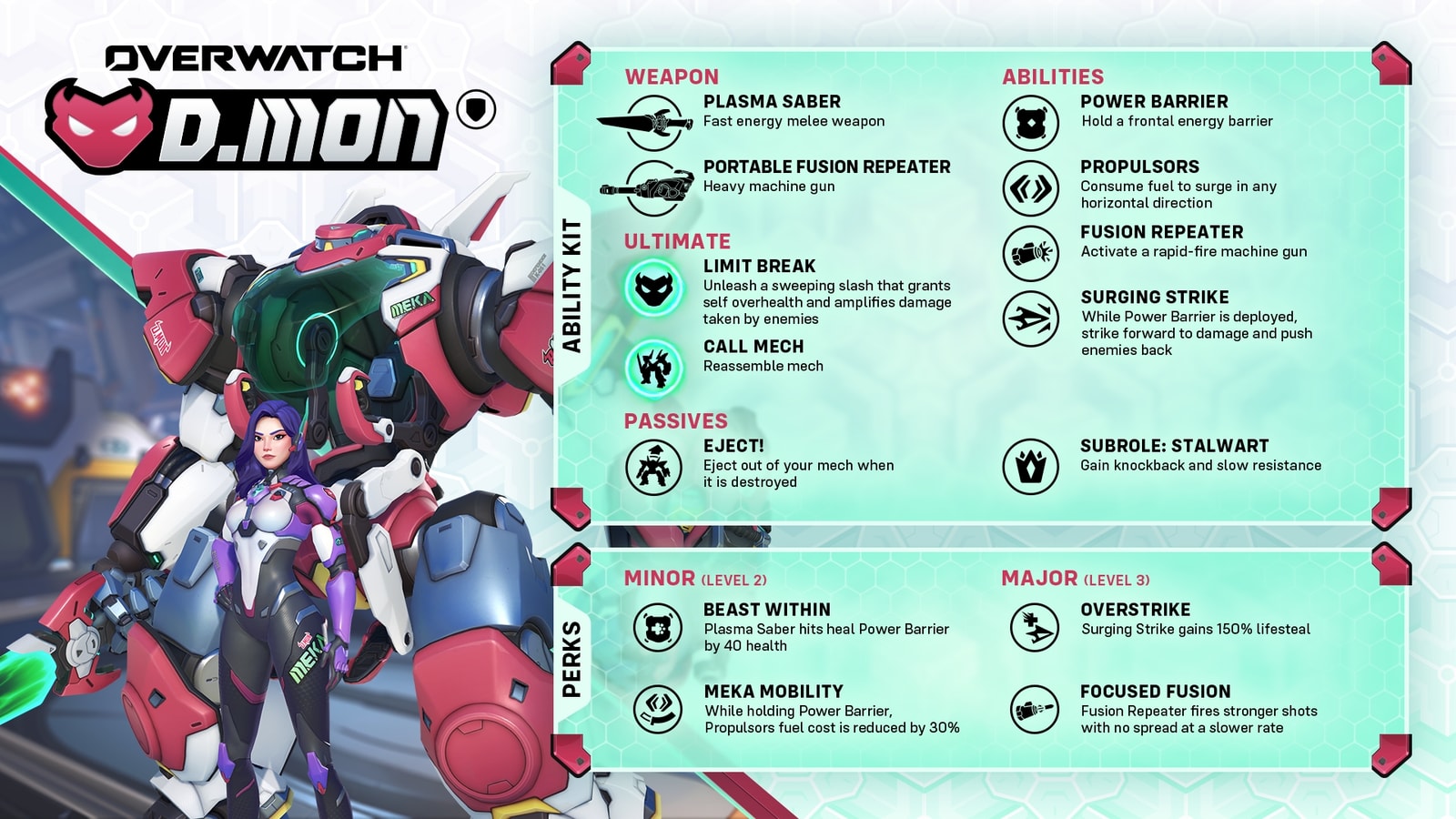
She also carries the Stalwart sub-role, which reduces incoming slows and knockbacks. On a hero whose entire game plan is walking into a fight and staying there, that is not a footnote — it is the difference between reaching the backline and being kited into next week.
Why she is not D.Va
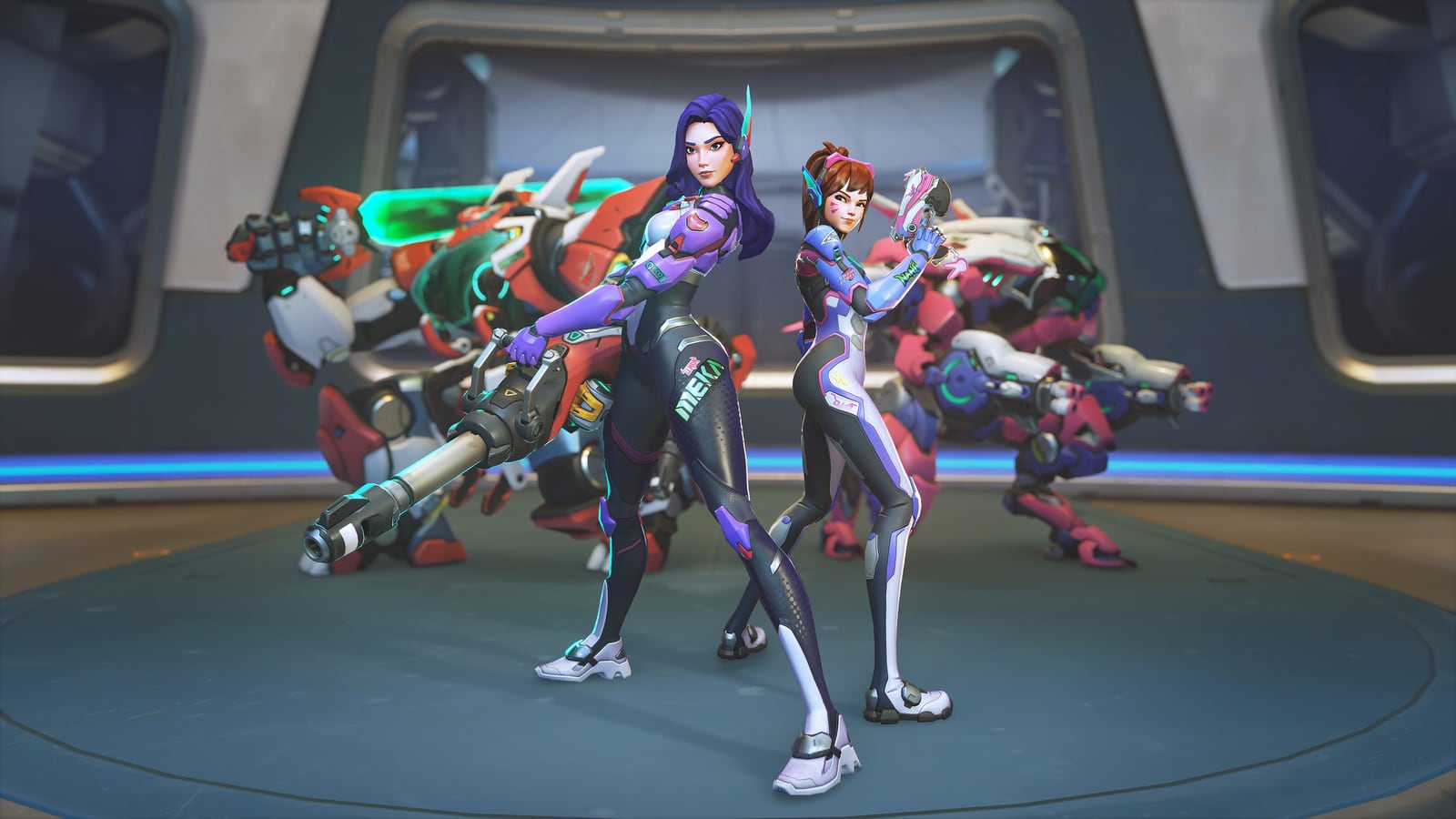
Two differences do most of the work. The first is that Propulsors are horizontal only. D.Va’s boosters take her over walls, onto high ground, and out of danger vertically; D.Mon’s move her along the floor and nowhere else. She cannot contest a perch, she cannot escape upward, and any fight that involves height is a fight she is losing before it starts.
The second is the damage profile. D.Va threatens at range with spread and pressures from mid-distance. D.Mon has almost no meaningful output until she is inside melee range, with the Fusion Repeater as a stopgap rather than a real weapon. She is a brawl tank in the Reinhardt lineage wearing a mech, not a dive tank.
The similarity that does survive is Eject. When the mech dies you are a squishy with a gun, and the same rule applies as it always has: your job in pilot form is to survive and rebuild, not to duel.
Perks
Minor perks (level 2)
- Beast Within — Plasma Saber hits heal Power Barrier by 40 health, rewarding you for actually connecting rather than swinging at air
- MEKA Mobility — Propulsors cost 30% less fuel while you are holding Power Barrier, which is the mobility perk if you are working a choke
Major perks (level 3)
- Overstrike — Surging Strike gains 150% lifesteal, turning your engage into your sustain
- Focused Fusion — the Fusion Repeater fires stronger shots with no spread at a slower rate, giving you a real answer to targets you cannot reach
The perk choice is genuinely a fork rather than a formality. Beast Within into Overstrike doubles down on brawling: you sustain by hitting things, which is superb into other melee tanks and miserable when the enemy simply walks away. Focused Fusion is the concession that some maps and some compositions will not let you close, and having a functioning gun beats having a beautiful sword you never get to use.
How to play her
Hold the barrier while you walk, and use Surging Strike as the entry rather than as a finisher — the knockback is what creates the space your team steps into. Save fuel. Propulsors are the only way you get out of somewhere you should not be, and spending both charges on the approach is the single most common way new D.Mon players die.
Mid-fight, once your team has an advantage, Propulsors convert it: boost into a low-health target and take the kill. That is the moment she is strongest, and it is the moment most people are still holding the barrier out of habit.
Armour and cover matter equally. She is not a hero who face-tanks a choke — she is one who alternates between absorbing with the barrier, breaking line of sight to take healing, and re-engaging when a cooldown is down.
What beats her
- Verticality — she cannot go up, so anything holding high ground makes her irrelevant
- Hitscan and ranged poke — kite her fuel-limited melee kit and she does nothing for the whole fight
- Flankers — Power Barrier is frontal, so anyone behind her is hitting a tank with no shield
- Focusing the pilot — the moment the mech breaks, she is the softest target on the map
She shares most of these weaknesses with Reinhardt and Doomfist, which is a useful shortcut: if a map or a composition is bad for those two, it is bad for D.Mon.
Who she plays with
Rush compositions. She wants a Lucio to speed the walk-up and a support pairing that can commit to the same fight rather than hanging back, because a D.Mon whose healers are playing at range is a D.Mon dying alone in the enemy backline. She is not a hero you flex onto a poke composition and hope.
Is she worth learning right now?
Two things are true at once. New heroes are always over-represented and under-understood in the weeks after release, so there is genuine free rating in knowing a hero the lobby does not. But she released alongside a rank reset, which means the ladder is already noisy and a hero you are still learning adds to that.
If you want to learn her, learn her in a season where the rating does not matter to you. If you want the rank first and the hero second, that is what our boosting and coaching exist for — and a coaching session with a Grandmaster tank player is a far faster route to understanding fuel management than fifty solo games of finding out.