Heroes9 min read
Doctrine: Overwatch’s new vampire support, explained
Doctrine is Overwatch’s 54th hero, a vampire support arriving in Season 5. His full kit, what Infuse actually does, the Deliverance ultimate, both perk tiers, and whether he is worth learning.
Overwatch has fifty-three heroes and not one of them has a weapon like this. Doctrine’s Eternal Scepter passes through Reinhardt’s shield. It passes through Sigma’s. Defense Matrix does not eat it, Genji cannot deflect it, and Winston’s bubble is a decoration. And then, in the same breath, it refuses every buff in the game: Mercy cannot boost it, Baptiste’s Amplification Matrix does nothing to it, no damage amp touches it at all.
That combination does not exist anywhere else in Overwatch, and Blizzard has not explained it. The hero deep dive covered his abilities in detail and skipped straight past the strangest thing about him. So let us start there, because once you understand what that weapon is for, the rest of the kit stops looking like a pile of vampire references and starts looking like a deliberately built machine.
The man in the cell
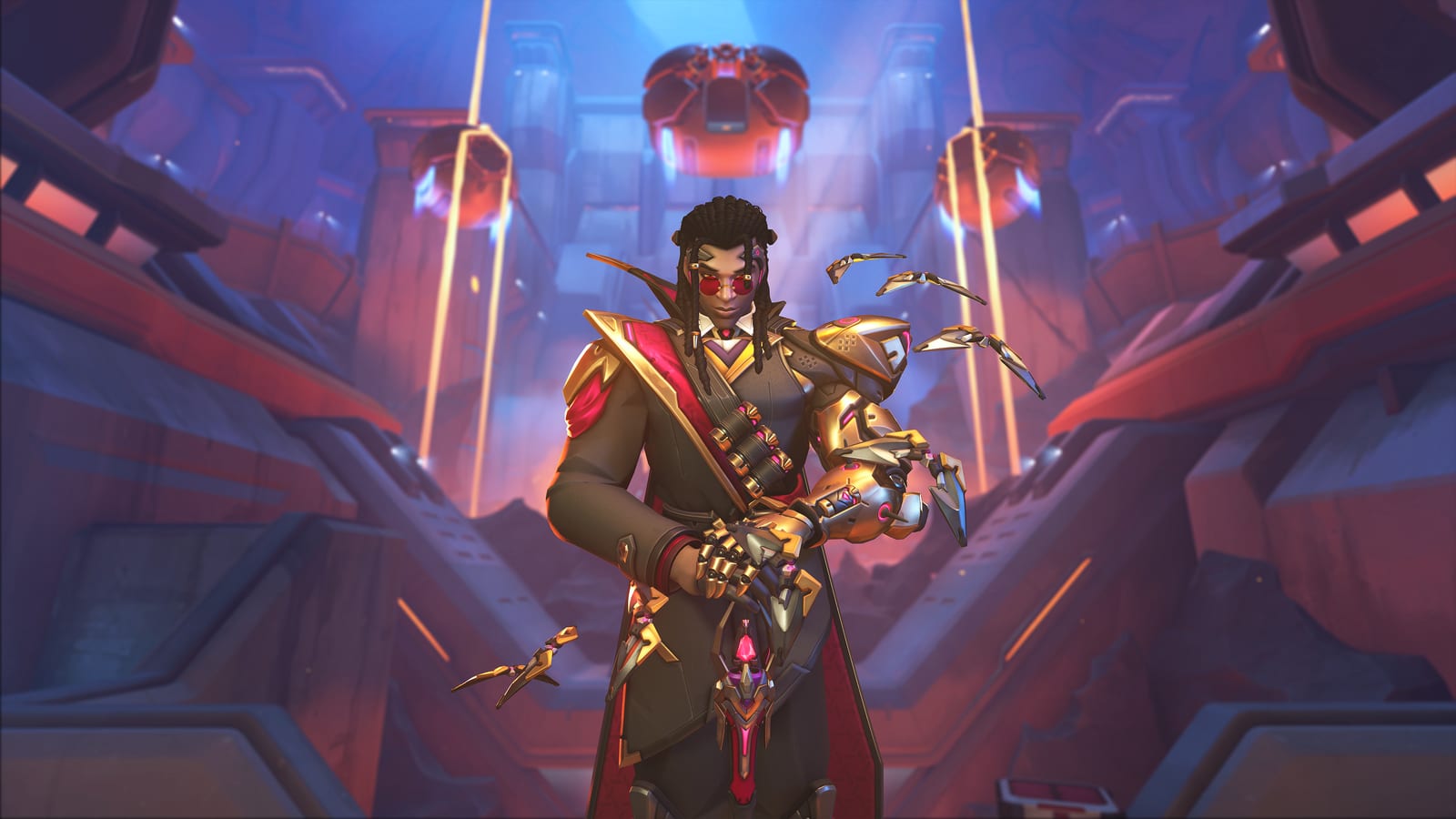
Doctrine is Tamuka Yeukai, Zimbabwean, seventy-seven years old and looking about forty — which, given what he does for a living, is the point. Narrative designer Eleni Gallardo gave him a motive that is much better than the marketing suggested: he was a scientist who built life-draining technology to cure his brother’s disease. It worked. He was imprisoned for it.
By Ana. And Freja.
Sit with that for a second, because it is the most elegant thing in the whole reveal. Overwatch now has two supports who heal their team by shooting them with a rifle, and one of them put the other in a cage. Ana’s entire character is a woman who chose not to take a shot and has spent decades living with what that cost. Doctrine is the man she did lock away, whose crime was saving someone he loved using a method she found unacceptable. Doomfist breaking him out of that cell is not a generic villain jailbreak. It is a specific argument about who gets to decide what a cure is allowed to cost.
His line is “Death is not my destiny.” From a man who watched his brother nearly die and built something monstrous to stop it, that reads less like a boast and more like a grudge.
The Eternal Scepter
Hitscan. 18 ammo, 1.5 second reload, 1.67 shots per second. Every shot either damages an enemy or heals an ally, the same way Ana’s rifle does — and the developers described it in exactly those terms, as a more lethal version of the Biotic Rifle.
- Damage — 60, falling off to 18 between 30 and 50 metres
- Healing — 60, on the same falloff curve
- Infused damage — 90, falloff pushed out to 40–60 metres
- Infused healing — 120, same extended range
- Headshots — yes, at 1.5×, but only on uninfused shots
Run the maths and he heals for roughly 100 per second on a single target, which is a shade above Ana. The lethality the developers mentioned is not really the damage number, though — it is that Ana’s rifle cannot crit and his can. A body shot is 60. A headshot is 90.
Which produces the first genuinely interesting decision in the kit: an infused body shot also does 90. Infusing buys you the damage of a headshot without having to hit one, plus the pierce, plus the range — but it explicitly cannot crit and adds 0.1s of recovery. So Infuse is not simply “more damage”. It is a trade of your aim for a resource, and if you are already hitting heads, spending a charge on damage is a downgrade.
Why it ignores everything
Here is the reading that makes sense of it. Every other hitscan in Overwatch has output that is a function of two things they do not control: what is in front of them, and who is behind them. A Soldier: 76 in front of a Sigma shield does nothing. The same Soldier behind a Mercy does 30% more. His value swings wildly based on the other nine people in the lobby.
Doctrine has been removed from both halves of that equation. Barriers do not reduce him and buffs do not raise him. He is a constant. Whatever the enemy composition is, whatever your support pairing is, his output is the same number — and that number is decided entirely by whether he hits.
This has a real consequence for how he will be balanced. Most heroes are tuned with the assumption that a pocket exists; the ones that get out of hand are usually the ones that scale too well with a Mercy. Doctrine cannot be pocketed into a problem. He can only be good or bad on his own, which means Blizzard can tune him much more tightly — and it means that if he is strong at release, nerfing him will be a scalpel rather than the usual argument about whether the hero or the buff was the problem.
It also means something less comfortable for you. If you have been carried by a Mercy before, none of that transfers. There is no version of a bad Doctrine game that a teammate fixes.
Infuse is the actual hero
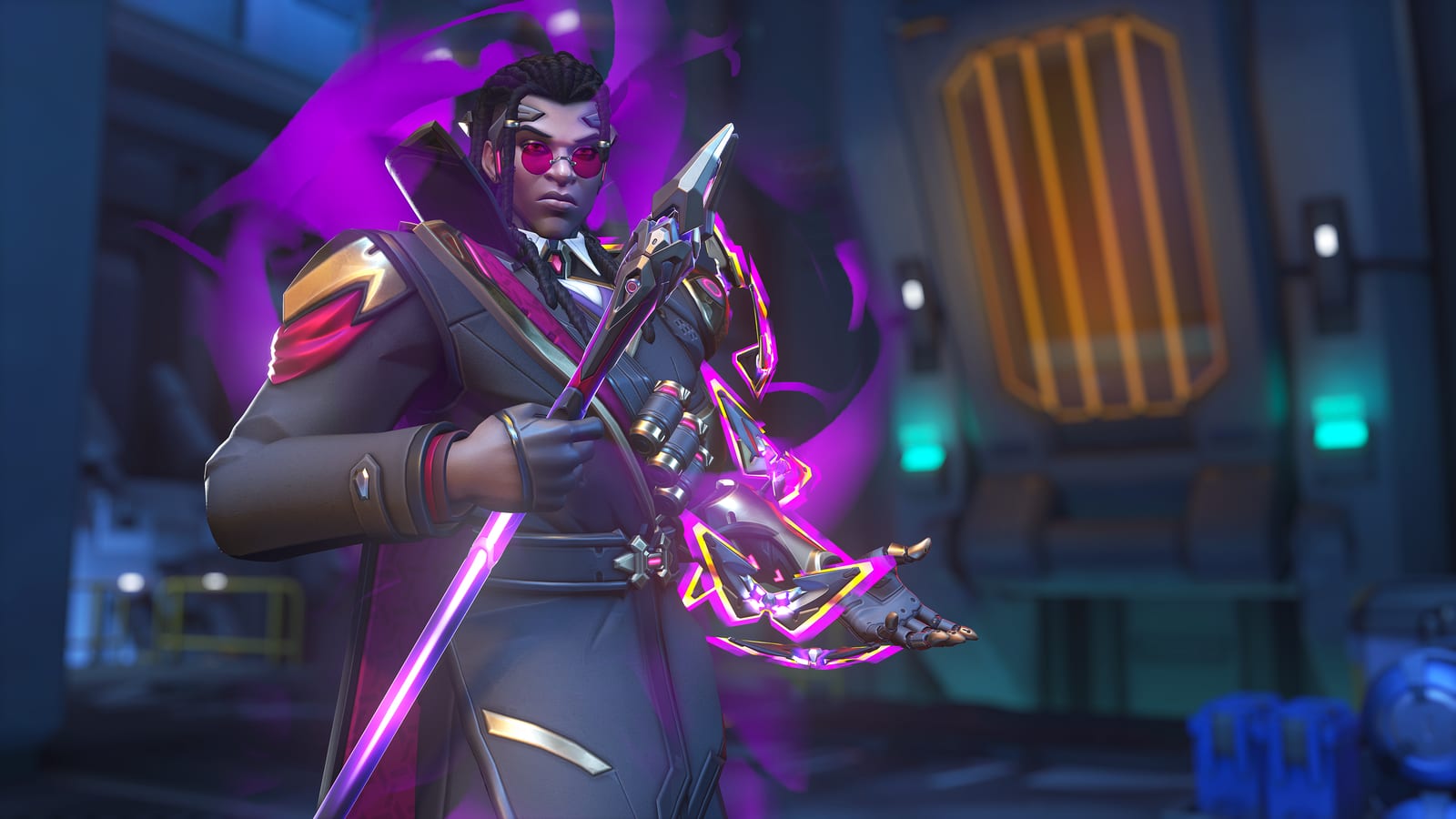
Right click. Eight second cooldown, two charges. It does nothing on its own — it empowers whatever you do next, and every part of the kit has a second, better version waiting behind it.
Hero designer Scott Kennedy put it plainly: deciding when to use or save Infuse charges is the thing that separates a good Doctrine from a bad one. That is an unusual claim for a support. Most supports are tested on positioning and aim. This one is tested on inventory management under pressure — you are holding two charges and continuously being offered reasons to spend them, and the correct answer is frequently “not yet”.
Two charges on an eight second cooldown means you are never far from having one, which quietly makes hoarding the default mistake rather than spending. But it also means burning both to win a fight you were going to win anyway leaves you with nothing for sixteen seconds, which is a very long time to be an ordinary hitscan support.
The rest of the kit
Shrouded Momentum
Shift. A 1.8 second horizontal rush at 12 m/s that ramps to +60% speed, with 50% damage reduction throughout. Infused, it starts at 15 m/s, ramps to +100%, and grants free flight.
Flight on a support is a big deal, and it is the single most likely thing to get tuned before release. Blizzard has not published the cooldown on this — nobody has it, not the wiki, not any outlet. That is the number to watch when the patch notes land, because a short cooldown on an infused flight makes him a genuinely different hero to a long one.
Invigorating Drones
E. Sends mechanical bats to an ally within 30 metres: 120 healing over six seconds, plus a 35% attack speed buff. Infused, he gets a set himself as well.
The attack speed is the part people will underrate. 35% is enormous on the right target and nearly worthless on the wrong one — it is a different ability entirely depending on whether you put it on a Bastion or a Reinhardt. Learning which teammate turns that buff into a won fight is most of the hero’s team-play skill.
Deliverance
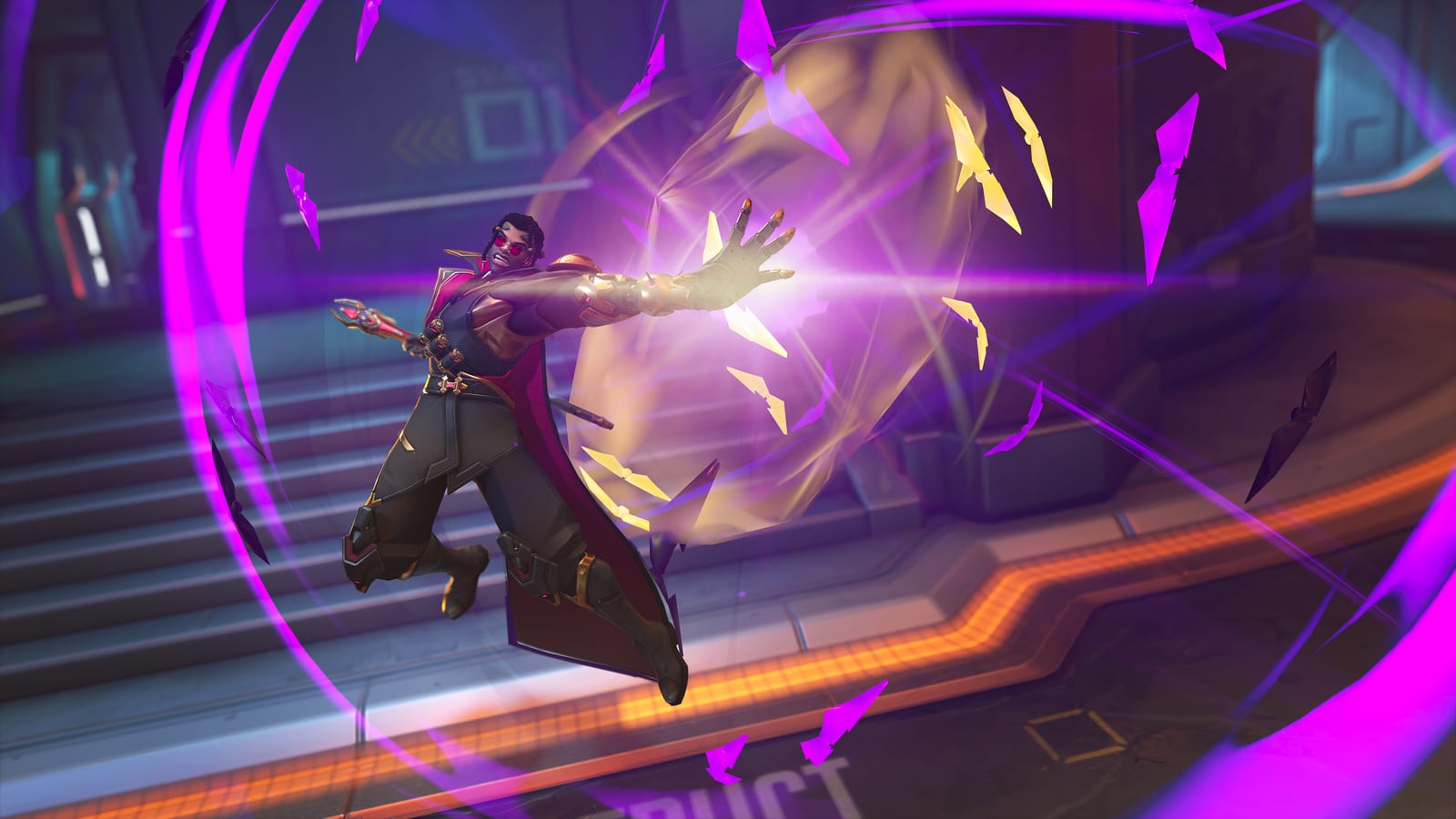
The ultimate costs 2,800, which is expensive for a support, and it deserves to be. He launches a swarm into a 12 metre radius for six seconds, with the effects decaying over eight. Each drone does 5 damage, 5 healing, and grants 15 overhealth up to a cap of 150.
The damage numbers are not the story. Deliverance reduces enemy maximum health while stacking overhealth on your own team, and reducing a maximum health pool is not the same as doing damage — it moves the breakpoints. Every combo the enemy team has practised now kills your team slightly slower, and every combo your team has now kills them meaningfully faster. It does not win a fight by killing anyone. It wins a fight by changing the arithmetic everyone in it is relying on.
Perks
Minor (level 2)
- Saving Grace — Invigorating Drones heal 40 immediately on application, turning a heal-over-time into a partial burst heal
- Sanguine Siphon — heal for 50% of the damage your infused scepter deals
Major (level 3)
- Transfusion — damage and healing dealt reduce Infuse’s cooldown, so the resource the hero is built around refills by playing well
- Cost of Life — sacrifice 25 maximum health, permanently, for 20% more scepter healing: 60 becomes 72, and infused 120 becomes 144
Cost of Life is the most on-theme perk Blizzard has ever written. You literally pay with your own life to heal other people better, and on a 250 health support, dropping to 225 is not a rounding error.
15% off, for reading this farTap to reveal the code
DOCTRINE15Paste it into the voucher box at checkout.
The thing nobody is mentioning: he has no panic button
Go back through the kit and look for the escape. Kiriko has Swift Step and Suzu. Moira has Fade. Baptiste has Immortality Field. Lucio has a wall and a boop. Mercy has an entire second movement system.
Doctrine has a 1.8 second dash with 50% damage reduction, and that is the entire list. There is no cleanse, no invulnerability, no reposition-instantly button. On 250 health — or 225 if you took Cost of Life.
His passive is the compensation. He carries the Survivor sub-role: using a movement ability starts passive health regeneration. That is not a get-out-of-jail card, it is a reason to keep moving between fights instead of standing still waiting to be topped up. Which is the same design thesis the developers gave for the whole season — lead hero producer Kenny Hudson and the team started from the question of whether healing has to be confined to the backline, and built three heroes around answering no.
Practically, it means Doctrine dies to exactly what you would expect. Dive him and he has one dash. Tracer, Genji, Winston, Doomfist, a Widowmaker with an angle — all of them beat a support whose only defensive tool is a short horizontal rush. Do not expect the barrier-piercing to save you when a Tracer is behind you, because piercing a barrier is irrelevant when the problem is standing next to you.
When you can actually play him
He is playable right now in a limited-time Hero Trial, which ends on 14 September. His real debut is Season 5 on 6 October, alongside Sombra’s rework into a support and a Roadhog rework that removes the hook one-shot.
Every number in this article comes from the trial build. Blizzard tunes heroes between trial and launch as a matter of routine, and the two unpublished cooldowns — Shrouded Momentum and Invigorating Drones — will tell you more about how he actually plays than anything listed above. Treat all of it as a strong draft rather than a final sheet.
Is he worth learning?
If you enjoy heroes where your output is entirely your own responsibility, he is the most purely individual support ever added to the game. No barrier protects the enemy from you and no teammate makes you better. That is either the most appealing sentence in this article or the least, and which one it is tells you whether to pick him up.
The usual new-hero warning applies. He will be over-represented and badly understood for weeks, which is free rating if you know him and a liability if you are learning him in games you care about. Season 5 also arrives with two reworks, so the ladder is going to be noisy regardless — learning a new hero in that is a choice to be noisy along with it.
If you want to climb first and learn him afterwards, that is what we are for. A coaching session with a Grandmaster support player will teach you Infuse discipline faster than fifty games of guessing, and if you would rather your rank were already sorted by the time Season 5 settles, our rank boosting does that part while you learn him in quick play.
Common questions
When is Doctrine available in Overwatch?
He joins the permanent roster in Season 5 on 6 October 2026. He was playable earlier during a limited Hero Trial from 12 to 14 September, disabled in ranked for the duration.
What role is Doctrine?
Support, with the Survivor sub-role — using a movement ability starts passive health regeneration. He has 250 health.
What is Doctrine’s ultimate?
Deliverance, costing 2,800. It launches a drone swarm in a 12 metre radius that reduces enemy maximum health while granting allies overhealth — 5 damage, 5 healing and 15 overhealth per drone, capped at 150 overhealth.
Does Doctrine’s weapon go through shields?
Yes. The Eternal Scepter ignores barriers, Defense Matrix and Deflect. It also cannot be damage boosted or run through Amplification Matrix, so his output is the same regardless of who is on either team.
Is Doctrine hard to play?
The aim is ordinary hitscan support aim. The difficulty is Infuse — two charges on an eight second cooldown that empower whatever you do next, so the skill is deciding when not to spend them. He also has no escape beyond a 1.8 second dash, which makes him fragile against dive.